Holographic Grating Machine
Two-beam interference system for recording diffraction gratings
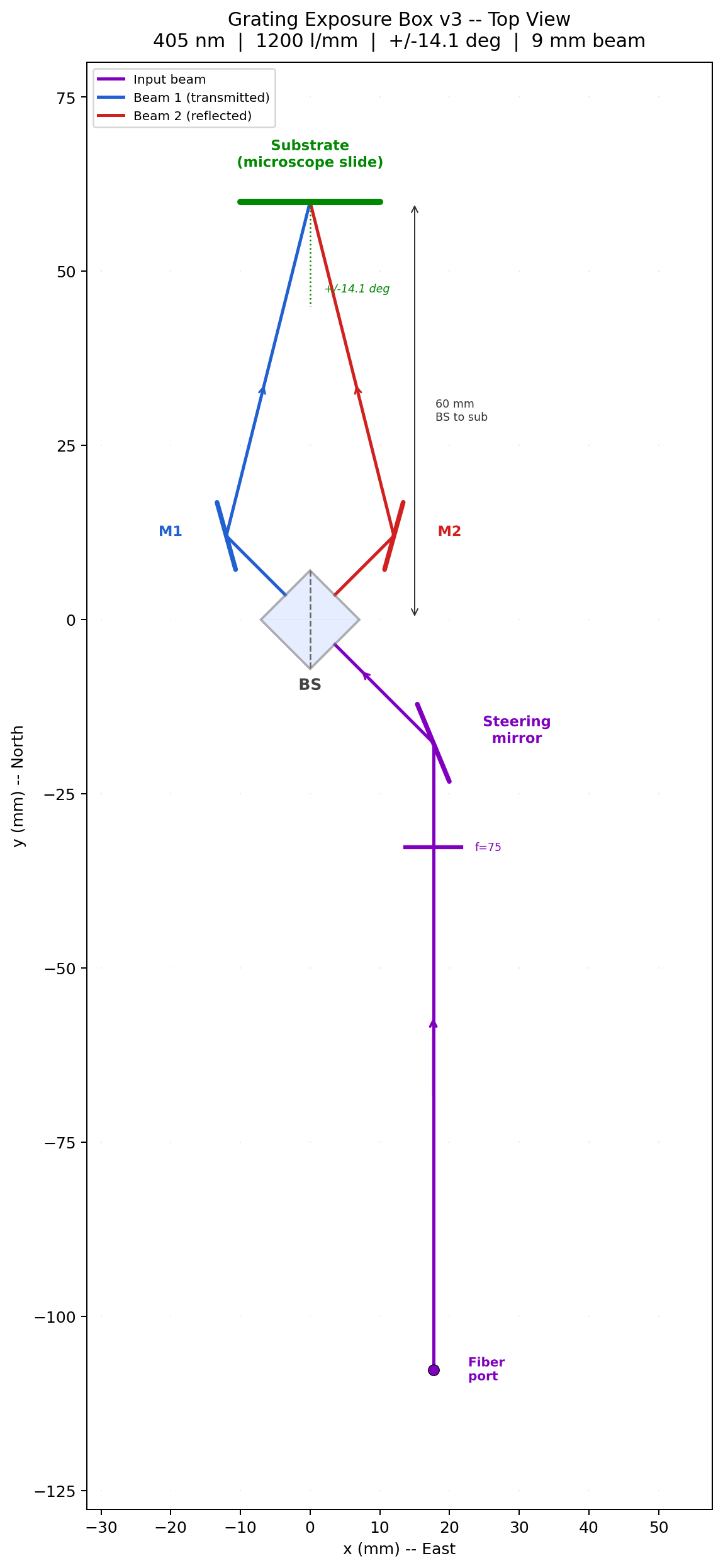
A machine for recording holographic diffraction gratings on photoresist-coated microscope slides. Two coherent beams from a 405nm laser diode interfere at a controlled half-angle, exposing a sinusoidal fringe pattern at 1200 lines/mm in the photoresist. After development, the result is a surface-relief diffraction grating.
This is part of a larger project: building a Czerny-Turner spectrometer to characterize a ~485nm laser diode, toward eventually building an external-cavity diode laser (ECDL) for Rubidium Rydberg atom electrometry.
Optical design
A fiber-coupled 405nm diode laser feeds into a collimating lens, then a steering mirror redirects the beam into a beamsplitter cube oriented in diamond configuration. The transmitted and reflected beams are redirected by mirrors M1 and M2 to converge at the substrate on the north face. The layout is symmetric, giving zero path-length mismatch between the two arms – critical for maintaining coherence and fringe visibility.
The two-beam interference condition \(d = \lambda / (2\sin\theta)\) sets the half-angle at 14.06\(^\circ\) for 1200 lines/mm at 405nm. The power budget is forgiving: only ~0.15 mW is needed at the substrate, and even a multimode fiber source provides orders of magnitude more than that.
Mechanical design
The housing is a 3-part aluminum construction designed for CNC machining on a Haas TM1:
- Base billet with channels milled from the top, precision pockets for mirrors and beamsplitter, and a fiber port
- Lid with dowel pins for repeatable alignment
- Slide cap bolted to the north face with a slit for slide insertion, a thumbscrew clamp, and an anti-reflection exposure window
All mirrors are epoxied into machined pockets at fixed angles – no adjustable mounts. The machining tolerances set the alignment. This is a deliberate choice: once the geometry is right, there’s nothing to drift.
Photoresist process
Shipley S1800 series photoresist on standard 75x25x1mm glass slides. Target dose is 50-100 mJ/cm\(^2\) at 405nm, with exposure times of 30-60 seconds (short enough to be insensitive to vibration on a granite surface plate).
Tools
geometry_v3.py– ray geometry calculations and diagram generationexposure_box_v3.scad– full parametric OpenSCAD model (base, lid, slide cap, assembly, cross-section views)fringe_sim.py– fringe pattern simulation