Energy Flows Into Wires, Not Through Them
Inspired by a problem from PHYS 3327 (Advanced Electricity and Magnetism) at Cornell University.
Electromagnetic energy does not flow along a wire. It flows into the wire, from the surrounding fields. The wire is not a pipe for energy, but a sink.
Consider a long straight wire of radius \(a\), conductivity \(\sigma\), carrying a steady current \(I\). The electric field inside the wire follows from Ohm’s law. The current density is \(\mathbf{J} = \sigma \mathbf{E}\), and \(J = I/\pi a^2\), so:
$$\mathbf{E} = \frac{I}{\sigma \pi a^2}\,\hat{\mathbf{z}}$$
This is uniform throughout the wire and points along it. The magnetic field at some radius \(r\) from the axis comes from Ampere’s law. Outside the wire (\(r > a\)):
$$\mathbf{B} = \frac{\mu_0 I}{2\pi r}\,\hat{\boldsymbol{\theta}}$$
Inside the wire (\(r < a\)), the enclosed current scales as \(r^2/a^2\):
$$\mathbf{B} = \frac{\mu_0 I r}{2\pi a^2}\,\hat{\boldsymbol{\theta}}$$
Now compute the Poynting vector \(\mathbf{S} = \frac{1}{\mu_0}\mathbf{E}\times\mathbf{B}\), which gives the direction and magnitude of energy flow.
At the surface (\(r = a\)):
$$\mathbf{S}\big|_{r=a} = -\frac{I^2}{2\pi^2 \sigma a^3}\,\hat{\mathbf{r}}$$
The minus sign is the result: \(\mathbf{S}\) points radially inward. That tells us energy is flowing from the fields surrounding the wire into the wire, where it is dissipated as heat. To verify: integrate \(\mathbf{S}\) over the surface of a cylindrical section of length \(\ell\):
$$P = \oint \mathbf{S}\cdot d\mathbf{A} = \frac{I^2 \ell}{\sigma \pi a^2} = I^2 R$$
This is standard Joule heating, as expected.
Inside the wire, the Poynting vector still points inward, but its magnitude decreases toward the axis:
$$\mathbf{S}\big|_{r \lt a} = -\frac{I^2 r}{2\pi^2 \sigma a^4}\,\hat{\mathbf{r}}$$
At \(r = 0\), the energy flow is zero. The energy flowing inward through any cylindrical shell at radius \(r\) is exactly what gets dissipated as heat in the volume between \(r\) and the axis. Nothing is left to flow at the center.
So where is the energy actually traveling to the load? To see this, consider a real circuit: a coaxial cable powering a load. Coax is the cleanest case to analyze because the cylindrical symmetry makes the field geometry exact, but the same picture holds for any configuration. The inner conductor of radius \(a\) carries current \(I\) in \(+z\); the outer conductor at radius \(b\) carries the return current in \(-z\). A voltage \(V\) is maintained between them.
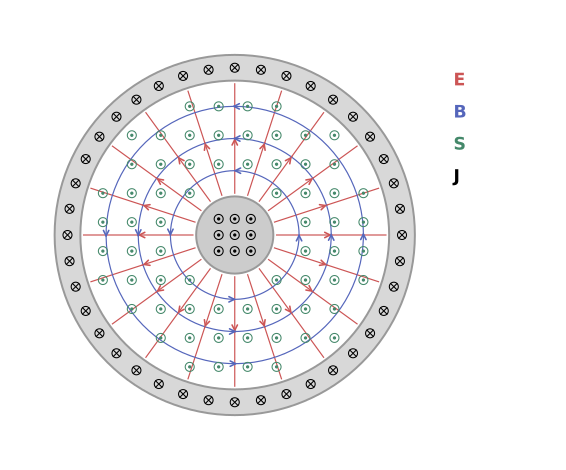
In the dielectric (\(a \lt r \lt b\)), Gauss’s law and Ampere’s law give:
$$\mathbf{E} = \frac{V}{r \ln(b/a)}\,\hat{\mathbf{r}}, \qquad \mathbf{B} = \frac{\mu_0 I}{2\pi r}\,\hat{\boldsymbol{\theta}}$$
The Poynting vector is:
$$\mathbf{S} = \frac{1}{\mu_0}\mathbf{E}\times\mathbf{B} = \frac{VI}{2\pi r^2 \ln(b/a)}\,\hat{\mathbf{z}}$$
This points purely in \(+z\) – toward the load. Integrate over the annular cross-section:
$$P = \int_a^b \frac{VI}{2\pi r^2 \ln(b/a)} \cdot 2\pi r\,dr = \frac{VI}{\ln(b/a)}\int_a^b \frac{dr}{r} = VI$$
The total power delivered is \(VI\), flowing entirely through the dielectric. None of it passes through the metal. The conductors set up the geometry (the radial \(\mathbf{E}\) and azimuthal \(\mathbf{B}\)), and the fields do the rest.
A wire in a circuit is essentially a waveguide – it guides electromagnetic energy through the surrounding space in exactly the same sense as a coaxial cable or a microstrip. The conductor sets up the geometry of currents and surface charges which generate the \(\mathbf{E}\) and \(\mathbf{B}\) fields, and those fields carry the energy. Longitudinal energy transport happens in the dielectric, not in the metal.
(A caveat: everything above describes steady-state DC. The fields and surface charges are themselves established causally, propagating at the signal velocity of the structure when the circuit is first energized. The steady state is what remains after this transient has settled.)