Spontaneous symmetry breaking: from superconductivity to the Higgs mechanism
Originally written for PHYS 4444 (Introduction to Particle Physics) at Cornell University. Download the original paper (PDF).
Introduction
Superconductivity and the Higgs mechanism are both topics which are of sufficient importance to physics that they often find themselves being covered in the mainstream media. Both being complex topics far removed from the typical daily experiences of most in the public, they often suffer from being explained with confusing analogies which do nothing to actually explain the topic to the audience.
Both topics are interesting, have a rich history of exploration, and come from a beautiful theoretical underpinning. Both even arise from analogous situations resulting from spontaneous symmetry breaking, making them interestingly similar in some respects.
The purpose of this text is to serve as a guide for those who do not have a formal education in physics; but who have a strong desire to learn more. Specifically, a guide to outline the history and underlying physics of superconductivity, and the Higgs mechanism. While not sufficient on its own to come to a complete understanding of these topics (something not even the author has), it serves to point the reader in the directions necessary to learn more about these topics without getting lost.
Superconductivity
In typical materials, such as ordinary copper, we often speak of a property called electrical resistance. This property is a measure of resistance to flow of electrical current through the material. It is convenient to classify materials based upon their resistivities, because materials with similar resistivities share similar electrical properties. The most common way the boundaries are drawn is somewhat blurry, but broadly speaking materials with high resistivities are called insulators, materials with low resistivities are called conductors, and materials with values somewhere “in-between” are called semiconductors. Materials are known across many orders of magnitude of resistivity, ranging from conductors such as aluminum to insulators such as rubber. Despite this, it was thought that all materials would display some degree of electrical resistance – that is, classical models of conductivity did not provide any mechanism for a material with zero resistance to exist, and so none were predicted.
This changed in 1911, however, when Heike Onnes was performing experiments regarding the effect of low temperatures on the resistance of materials. Onnes noticed that at 4.19 K, the resistivity of his mercury sample suddenly dropped to zero – he had discovered the phenomenon of superconductivity. In the coming years, more examples of superconducting states would be found in other materials and at different temperatures, but little progress was made in developing a theoretical model explaining the effect.
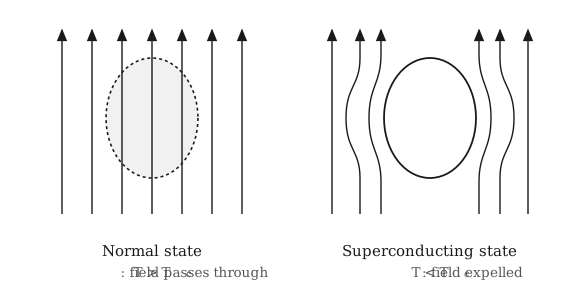
The next finding that would help to characterize superconductivity was the discovery of the Meissner effect in 1933 by Meissner and Ochsenfeld; this is the effect by which a material during its transition to superconductivity expels all magnetic fields from its interior (see figure 1). The discovery of this effect was particularly important because it showed that superconductivity involves more than just having zero electrical resistivity. Indeed, the discovery proved so important that it enabled the creation of the first theoretical model for superconductivity: the London constitutive equations, developed by Fritz and Heinz London just two years later in 1935.
London constitutive equations
This first model for superconductivity is purely classical. As mentioned previously, materials across a huge range of resistivities are known; likewise, they all behave more-or-less according to Ohm’s law insofar as it predicts electrical current through a material will be linearly proportional to the electric field across the material. Because this linearity is not possible because of the resistanceless nature of superconductors, the Londons motivate their model by arguing that the electrons traveling with no resistance are essentially free. Then the Lorentz force suggests that a uniform electric field should excite a uniform acceleration of the electrons. The Londons suggested the following relationship:
$$\partial_t\mathbf{J}=\frac{n_se^2}{m}\mathbf{E}$$
where \(e\) is the electron charge, \(m\) is the mass of the electron, \(\mathbf{J}\) is the current density, and \(n_s\) is a constant roughly related to the number density of carriers.1 From this first equation, they take the curl and use Faraday’s law to find a second equation:
$$\nabla\times\mathbf{J}=-\frac{n_se^2}{m}\mathbf{B}$$
These are the two equations describing the model as typically presented when dealing in terms of observable fields. However, they can also be combined into a single equation in terms of the vector potential:
$$\mathbf{J}=-\frac{n_se^2}{m}\mathbf{A}_s$$
However, in order for this to be valid, all gauge freedom in the vector potential has to be given up. The gauge choice which properly allows for interpreting the vector potential as a current density is known as the London gauge, and requires \(\nabla\cdot\mathbf{A}_s=0\), \(\mathbf{A}_s=0\) in the bulk material, and \(\mathbf{A}_s\cdot\mathbf{n}=0\) where \(\mathbf{n}\) is the surface normal.
At this point it is important to note the London equations are somewhat similar to Ohm’s law in that they do not explain superconductivity, much as Ohm’s law does not explain usual conductivity. Instead they simply attempt to model some of the behaviors seen in superconductivity through restricting Maxwell’s equations.
If we apply Ampere’s law to the second equation, we get the following:
$$\begin{aligned} \nabla\times\nabla\times\mathbf{B}&=-\frac{\mu_0n_se^2}{m}\mathbf{B}\\ &=-\frac{1}{\lambda^2}\mathbf{B} \end{aligned}$$
where \(\lambda\) has been defined as \(\sqrt{m/\mu_0n_se^2}\). Continue:
$$\begin{aligned} \nabla\times\nabla\times\mathbf{B}&=\nabla(\nabla\cdot\mathbf{B})-\nabla^2\mathbf{B}\\ \nabla\cdot \mathbf{B}=0\implies&=-\nabla^2\mathbf{B}\\ \implies\nabla^2\mathbf{B}&=\frac{1}{\lambda^2}\mathbf{B} \end{aligned}$$
This is the Helmholtz equation in the magnetic field – its solution gives \(\lambda\) as the characteristic length across which magnetic fields are expelled, and it is known as the London penetration depth. The modeled magnetic field strength at a distance \(x\) into the superconductor then looks like
$$\mathbf{B}(x)=\mathbf{B}_0e^{-x/\lambda}$$
Ginzburg-Landau theory
A decade and a half after the work of the Londons, in 1950 the Ginzburg-Landau theory was given by Ginzburg and Landau. Their theory is a phenomenological model which was given as an attempt to describe type-I superconductors without concern for their microscopic properties. The theory builds upon Landau’s earlier work with second-order phase transitions, using the work to argue that the superconductor’s free energy when near the transition point can be expressed as a complex field:
$$\psi(r)=|\psi(r)|e^{i\phi(r)}$$
Similarly to the wavefunction of quantum mechanics, here \(|\psi|^2\) gives a local density. Here however \(\psi\) serves as an order parameter, zero above a transition to superconductivity, and nonzero below. They give a form for the free energy as
$$F=F_n+\alpha|\psi|^2+\frac{\beta}{2}|\psi|^4+\frac{1}{2m}|(-i\hbar\nabla-2e\mathbf{A})\psi|^2+\frac{|\mathbf{B}|^2}{2\mu_0}$$
with \(F_n\) being the free energy in the non-superconducting phase, \(m\) is an effective mass, \(e\) the electron charge, \(\mathbf{B}\) is the magnetic field, \(\mathbf{A}\) is the magnetic vector potential, and \(\alpha\) and \(\beta\) are phenomenological parameters.2 They then use a variational approach in the vector potential and order parameter to minimize the free energy, arriving at the Ginzburg-Landau equations:
$$\alpha\psi+\beta|\psi|^2\psi+\frac{1}{2m}(-i\hbar\nabla-2e\mathbf{A})^2\psi=0$$
and
$$\begin{aligned} \nabla\times\mathbf{B}&=\mu_0\mathbf{J}\\ \mathbf{J}&=\frac{2e}{m}\Re[\psi^*(-i\hbar\nabla-2e\mathbf{A})\psi] \end{aligned}$$
One of the main new ideas contributed to the general understanding of superconductivity by the GL theory was the prediction of a new characteristic length. That is, one in additional to the penetration depth, which this theory also predicts. The new characteristic length is called the coherence length, \(\xi\). It is the scale according to which perturbations to superconducting electron density recover their equilibrium. Furthermore, Landau introduced a new parameter (now called the Ginzburg-Landau parameter), \(\kappa\), which is simply the ratio of the two characteristic lengths: \(\kappa=\lambda/\xi\). Landau proposed that this parameter may control the distinction between type-I and type-II superconductors: those with \(0<\kappa<1/\sqrt{2}\) being type-I, those with \(\kappa>1/\sqrt{2}\) being type-II.2
Bardeen-Cooper-Schrieffer theory
During the 1950s, improvements in the understanding of superconductivity began to be made at a more rapid pace. Fritz London proposed that the London equations could result from coherence in a quantum system. Bardeen would go on to argue that a theory with an energy gap would automatically lead to a coherence length-type scale parameter, which is precisely the modification seen with the London equations. It was around this time that an energy gapped theory was looking more attractive, but no source for this gap could be discerned.
Cooper pairs
One of the best and most simple models for the behavior of (valence) electrons in a metal is to simply consider them as a free gas. However, this is not truly the case. The electrons exist among the lattice formed by the positively-charged metal ions, and for a more complete picture of the situation they must be included. Just as the electrons repel other electrons because of their shared charges, the electrons attract all of the lattice ions because of their different charges. This attraction slightly disturbs the lattice, as the lattice members move very slightly closer to the electron (see figure 2). This increases the positive charge density in the region, and in some cases can actually become so great as to actually attract another electron – overcoming their mutual repulsion, and forming a bound state.3
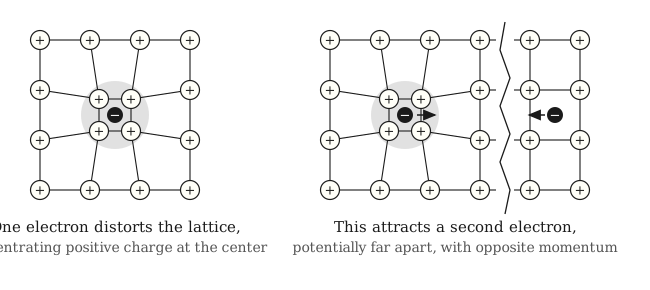
These bound states of two electrons are known as Cooper pairs, or BCS pairs. Notably, the binding is very low energy, such that any disturbance can easily destroy the pairs. This includes even thermal effects, so Cooper pairs can only form in low temperature environments. The full treatment of the dynamics of this pairs is not possible simply classically, because the mechanism leading to the formation of the pairs is quantum mechanical in nature. Because electrons are fermions, with spin half, a bound state of two of them has integral total spin, which means that Cooper pairs are bosons. Interestingly, the Pauli exclusion principle does not apply to them because of this fact. As such, an arbitrary number of the pairs are able to simultaneously occupy the same quantum state.
Band theory and electronic structure
When discussing the dynamics of electrons in a solid, it is usually through the lens of band theory. Band theory posits that the electrons within a solid may have only certain energies, and that these energies come in bands of permissible and forbidden energies.
Because of the Pauli exclusion principle, multiple electrons may not occupy the same quantum state. Because of this, when atoms join into molecules, their orbitals undergo hybridization and the electron energy levels split. Within a bulk solid such as a metal lattice, a large number \(N\) of atoms’ orbitals all “overlap”. They must hybridize in a similar fashion, however each energy level must split into \(N\) levels so as to not violate Pauli exclusion. Because Avogadro’s number is so large, the spacing between the split energy levels becomes incredibly small. Thus, each original energy level from a lone atom gets “smeared out” into a band of essentially continuous (by virtue of the extremely tight spacing) energy levels available for occupation.4 See figure 3.
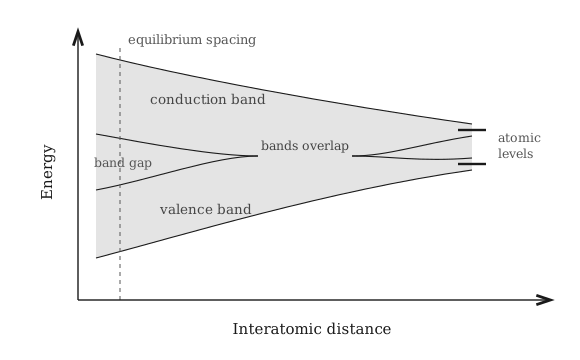
Just as there are gaps between the original energy levels, there are likely to be gaps between the continuous bands. These gaps between the bands are aptly known as bandgaps, and they represent energies that are not available for electrons to occupy.
Further important to the band theory of solids is the concept of the Fermi level. This is the energy that, if a state exists at this energy, the state would have a 50% chance of being occupied, as according to the Fermi-Dirac distribution:
$$f(\epsilon)=\frac{1}{e^{(\epsilon-E_F)/k_BT}+1}$$
where \(f\) is the probability of a state of energy \(\epsilon\) being occupied at temperature \(T\) with Fermi level \(E_F\). Another way of describing the Fermi level is that it is the value for \(E_F\) such that \(f(E_F)=1/2\). The relationship between the Fermi level and a material’s band structure is of fundamental importance for determining the material’s electronic properties. For example, in an insulator, the Fermi level lies within a large band gap, so it is difficult to excite electrons into the current-carrying conduction band. However, in a metal, the Fermi level lies inside a band, and so many states are able to carry current. Indeed, the Fermi level is actually the energy used to determine which bands even are the valence and conduction bands – they are the bands which are closest to the Fermi level. In non-metals (because the Fermi level lies within a band for metals, there is no meaningful way to distinguish between valence and conduction bands), the valence band is the band containing the highest energy electrons (at absolute zero) and the conduction band is the one which contains the lowest energy unoccupied states.
Bose-Einstein condensation and thermal conductivity
As noted in the section discussing the formation of Cooper pairs, bosons are not subject to the Pauli exclusion principle and therefore can have multiple occupancy of states. As a thought experiment, consider a gas of fermions at some finite temperature. They will have an energy distribution governed by Fermi-Dirac statistics, revolving around their inability to occupy the same quantum state. Consider what would happen if these particles were all instantaneously turned into bosons by some mechanism which is not of importance. How would the energy structure of the particles evolve? Although the particles are “able” to fall to the ground state, there is a great differential in energy that needs to be able to go elsewhere. Extracting this energy thermally through cooling the gas would lead to one immediately noticing an enormous spike in the gas’s heat capacity. This is because the energy spectrum of the gas is not characteristic of a Bose gas, it was a Fermi gas momentarily earlier. So, a great deal of energy needs to be extracted from the system in order to continue lowering its temperature.
Eventually however, with continued cooling, the gas will thermalize and its temperature will continue to drop. If the temperature becomes sufficiently low, a state can be reached where a significant majority of the particles are all in the ground state simultaneously. This is known as a Bose-Einstein condensate, and such a state is interesting because quantum mechanical interference effects can manifest themselves on macroscopic scales not typically seen.
These effects were important to the development of BCS theory, because they help to provide evidence for the theory being a proper explanation of superconductivity. As will be discussed later, BCS theory predicts that we would see the hypothetical increases in heat capacity mentioned above. Indeed, we do observe this very effect in some materials. Critically, to determine whether these heat capacity changes are due to the material being in the superconducting state or not, it is actually possible to lower the material below superconducting temperature without actually transitioning to the superconducting state. How is this possible? Recall the Meissner effect from section 2, the effect which is responsible for the complete expulsion of magnetic fields from the bulk of the superconductor. This expulsion ability is not infinite – there is a critical field intensity beyond which the expulsion fails and the materials collapses out of the superconducting state. By imposing this field while the material is not superconducting, and then lowering the temperatures below the superconducting temperature, the properties of the material can be probed with assurance that the superconducting state is not influencing the measurements. Precisely this type of experiment was performed on vanadium near its critical temperature. It was found that there is an exponential increase in the sample’s heat capacity when superconducting compared to the normal state. With vanadium in particular, this increase is roughly one-hundredfold over a span of only 4 K, and serves as evidence in favor of BCS theory.5
Transition to superconductivity
As previously established, when temperatures are sufficiently low, electrons can begin to bind into Cooper pairs. Importantly, however, if the temperature is low enough we can also ensure that specifically those electrons near the Fermi level are able to bind into Cooper pairs. In that way, it will be electrons in the form of Cooper pairs which serve as the primary charge carriers. As the temperatures decrease further, the Cooper pairs are able to drop into their ground states as energy is extracted from the system. As this happens, a band gap in energies begins to form. This is because the ground state energy of the Cooper pair is substantially lower than the energy level of the lowest unoccupied electron states – the electrons are literally disappearing as they are being bound into the Cooper pairs. In fact, because the bandgap is related to the occupancy of the ground state, breaking a single Cooper pair would result in changing the energy of the entire condensate. As such, the energy to break any pair is a function of the energy it would take to break all pairs. Because of this, the Cooper pairs have been effectively stabilized. This has the implication that scattering events from the lattice are suppressed, and so the charge carriers are able to move through the lattice completely free of resistance.
The Higgs mechanism
According to the Standard Model, there was an interesting discrepancy in that all bosons are expected to be massless. However, the bosons mediating the weak interaction are found to be quite massive. The Higgs mechanism is the manner in which these particles, which are expected to be massless, are able to acquire mass. The electroweak theory of the Standard Model to which the Higgs applies is not an Abelian theory, but it helps to start with an Abelian example to introduce how the Higgs mechanism functions. Before that though, it is useful to have a proper understanding of symmetries and how they can be broken.
Symmetry
Consider the Lagrangian density of an \(n\)-dimensional scalar field \(\phi=(\phi_1,\dots,\phi_n)\):
$$\mathcal{L}=\frac{1}{2}\left((\partial\phi)^2+\mu^2\phi^2\right)-\frac{\lambda}{4}\phi^4$$
In the one-dimensional case, the Lagrangian’s extrema can be found at \(\phi=0\), \(\phi=\pm v\), where \(v=\sqrt{\mu^2/\lambda}\). The first extremum is a maximum, and the other two are minima. These minima serve as the ground states for the system, and are called vacuum expectation values.6 Furthermore, the two equal ground states cannot be tunneled between, because when calculating the tunneling barrier there is an infinite contribution from the spacetime integral. This is a form of symmetry breaking, because in quantum mechanics there is normally a mirror symmetry \(\phi\to-\phi\) present, and it is not present here.
Consider taking the two-dimensional case. Simply from the behavior of the one-dimensional case, it should be easy to intuit that infinitely many minima will be generated around the central maximum. All of them have the same value: \(\sqrt{\mu^2/\lambda}\). Visually, the landscape looks like the Mexican hat potential. Since there is circular symmetry here, any choice of vacuum is arbitrary. So, I choose \(\phi=(v,0)\). We can introduce perturbations about the minima such that the 1-component moves radially, and the 2-component moves around the circle. Such fluctuations can be described with \(\phi_1=v+\phi_1’\) and \(\phi_2=\phi_2’\). This can be reinserted into the Lagrangian to see:
$$\mathcal{L}=\frac{1}{2}\left((\partial\phi_1)^2+(\partial\phi_2)^2\right)-\mu^2\phi_1^2+\dots$$
Notice there is no term in \(\phi_2\). As opposed to the \(\phi_1\) component, this shows that the \(\phi_2\) component is massless. Why is this important? To see the answer to that, we will have to move to an Abelian example.6
Abelian Higgs
A simple example of an Abelian gauge theory is electromagnetism, which has \(U(1)\) gauge symmetry. The electromagnetic 4-potential is invariant under gauge transformations: \(A_\mu\to A_\mu+\partial_\mu\chi\). The Lagrangian for electromagnetism incorporates the 4-potential, the 4-current \(J^\mu=(\rho,\mathbf{J})\), and the electromagnetic field tensor \(\mathbf{F}\):
$$\mathcal{L}=-\frac{1}{4}F_{\mu\nu}F^{\mu\nu}+A_\mu J^\mu$$
In an attempt to make the photon massive, try just simply adding a mass term!
$$\mathcal{L}=-\frac{1}{4}F_{\mu\nu}F^{\mu\nu}+\frac{1}{2}m^2A_\mu A^\mu$$
This breaks the \(U(1)\) gauge symmetry, and so cannot be the manner through which the boson acquires mass. Alternatively, we can modify the Lagrangian in other ways. Namely, we can add complex scalar field with self-interaction that also couples to our boson, and a corresponding charge \(e\):
$$\begin{aligned} \mathcal{L}&=-\frac{1}{4}F_{\mu\nu}F^{\mu\nu}+(D_\mu\phi)^\dagger(D^\mu\phi)-V(\phi)\\ D_\mu&=\partial_\mu-ieA_\mu\\ V(\phi)&=-\mu^2\phi^\dagger\phi+\lambda(\phi^\dagger\phi)^2 \end{aligned}$$
This Lagrangian is gauge invariant: \(A_\mu(x)\to A_\mu(x)-\partial_\mu\eta(x)\) and \(\phi(x)\to e^{ie\eta(x)}\phi(x)\). Consider how \(\mu^2\) affects the system. If it is negative, then there is a minimum energy at \(\phi=0\), and the symmetries of the Lagrangian are preserved. But if it is positive, then the field acquires a vacuum expectation value, resulting in spontaneous symmetry breaking.7 The vacuum expectation value has the form
$$\langle\phi\rangle=\sqrt{\frac{\mu^2}{2\lambda}}$$
Which is reparameterized definitionally to equal \(v\).
Then, the field itself can be written as
$$\phi=(v+h)e^{i\chi/v}$$
Here, \(h\) and \(\chi\) are respectively called the Higgs and Goldstone bosons. They describe real scalar fields which do not have vacuum expectation values. Knowing this, the form of the field reparameterized in terms of these fields can be substituted into the Lagrangian. Doing so leads us to
$$\begin{aligned} \mathcal{L}&=-\frac{1}{4}F_{\mu\nu}F^{\mu\nu}-evA_\mu\partial^\mu\chi+\frac{e^2v^2}{2}A_\mu A^\mu\\ &~~~+\frac{1}{2}(\partial_\mu h\partial^\mu h-2\mu^2h^2)+\frac{1}{2}\partial_\mu\chi\partial^\mu\chi+\mathcal{O} \end{aligned}$$
By reframing in terms of these Higgs and Goldstone fields, the photon appears to gain a mass \(ev\), and the Goldstone is massless. The mixing in the Lagrangian can be removed through choosing the unitary gauge and making the transformation \(A_\mu\to A_\mu’=A_\mu-\frac{1}{ev}\partial_\mu\chi\). After doing so, the Goldstone is no longer present in the theory (it has been “eaten”).76
This process, wherein the field acquires mass, and there is also a transfer of degrees of freedom, is the Higgs mechanism, and the field \(\phi\) is the Higgs field.
Analogies between superconductivity and the Higgs mechanism
There are multiple types of analogies which can be obtained between the presented models (including between the Higgs and the briefly-mentioned GL theory of superconductivity). There are also clearly places where no analogy can be found. For example, the formation of Cooper pairs is critical to the BCS model. Their formation serves as an instability to the Fermi surface resulting in the spontaneous symmetry breaking. There is no direct analog to this process in the Higgs mechanism.8
Perhaps the clearest analog between BCS theory and the Higgs mechanism is the symmetry breaking. In the Higgs mechanism, local \(SU(2)\times U(1)\) is broken, while in superconductivity global \(U(1)\) symmetry is broken.8 Some may argue that one being local and one being global actually makes this a formal disanalogy, I think that such a view misses the point of making such analogies in the first place. That is to say, by recognizing the similarities between these points, it helps us to understand the historical lens that led to a symmetry breaking mechanism being thought up to explain massive bosons, inspired by some accounts by BCS theory.
The expression for free energy used by the GL theory actually has the same form as the Higgs potential
$$V(\phi)=\mu^2\phi^2+\lambda\phi^4$$
This is not too surprising, given that both originate from Taylor expanding around a non-zero value of their corresponding order parameters – odd powers must be zero to maintain symmetry, and fourth-order terms are the lowest which can enable spontaneous symmetry breaking. Interestingly, if the Higgs had any higher orders, it would no longer be renormalizable.8
Further similarities can be seen with BCS theory. Both models involve approximating the Lagrangian/Hamiltonian, and then introducing small fluctuations, such as about the minimum potential in the Higgs mechanism. An interesting difference is that the approximation made in the BCS theory actually becomes exact in the thermodynamic limit, and this does not happen with the Higgs mechanism. Instead, it is argued that experimental energies are much too small to make high order fluctuations meaningfully contribute.
There is even an opportunity to search for physical/material analogies/disanalogies. One physical disanalogy between the Higgs mechanism and superconductivity is that the Higgs mechanism is not a temporal process. In the superconductivity models, there is a crucial variable of temperature which determines phase transitions. A dependence of changing temperature introduces an implicit dependence on time (temperature cannot be changed without the passage of time). The Higgs mechanism has no such dependence, as the Lagrangian for the (Abelian) Higgs model discussed here is time-independent.8
Conclusion
In conclusion, a brief outline was given of the history of superconductivity. We discussed how various discoveries contributed to the continued work in developing a theoretical model describing the phenomenon. From the London brothers introducing the London equations as restrictions on Maxwell’s equations, to the GL theory, and finally the BCS theory, the process of iterating on previous ideas is shown.
Then, the Higgs mechanism is introduced as a concept, and the situation that led scientists to develop the idea in the first place is addressed. A quick introduction to a scenario where symmetries can become broken was given, and this was contextualized with the Higgs mechanism as a consequence of such spontaneous symmetry breaking. After, a modified form of electromagnetism is used as a relatively simple Abelian example of how the Higgs mechanism serves to give some particles mass.
Finally, some analogies were discussed between the theories of superconductivity and the Higgs mechanism. Various manners in which the theories are analogous were identified, alongside several manners in which they are completely distinct. These include formal forms of analogy, such as how they both involve symmetry breaking, as well as physical (dis)-analogy, such as how they differ in whether they are temporal processes.
-
James F. Annett. Superconductivity, Superfluids and Condensates. Oxford University Press, 2013. ↩
-
P. C. Hohenberg and A. P. Krekhov. An introduction to the Ginzburg–Landau theory of phase transitions and nonequilibrium patterns. Physics Reports, 572:1–42, 2015. ↩↩
-
Leon N. Cooper. Bound electron pairs in a degenerate Fermi gas. Physical Review, 104(4):1189–1190, 1956. ↩
-
Sharon Ann Holgate. Understanding Solid State Physics. CRC Press, 2021. ↩
-
BCS Theory of Superconductivity. HyperPhysics, Georgia State University. http://hyperphysics.phy-astr.gsu.edu/hbase/Solids/bcs.html ↩
-
A. Zee. Quantum Field Theory in a Nutshell. World Publishing Corporation, 2013. ↩↩↩
-
Doreen Fraser and Adam Koberinski. The Higgs mechanism and superconductivity: A case study of formal analogies. Studies in History and Philosophy of Modern Physics, 55:72–91, 2016. ↩↩↩↩
Errata
- 2026-06-05 — Corrected seven typos present in the original (“incredible small” → “incredibly small”; “Goldstein” → “Goldstone”, twice; “can be obtains” → “can be obtained”; “this not not happen” → “this does not happen”; a dangling “because” removed from the BCS-fluctuations sentence; “disanology” → “disanalogy”; “materials electronic” → “material’s electronic”). The three figures shown on this page have been redrawn as original diagrams; the originals were adapted from third-party sources (a personal research page; a Physics Stack Exchange answer; Wikimedia Commons). The PDF preserves the paper as originally submitted, including its original figures.